
Your Period Is Talking
What your menstrual cycle is actually telling you about your health and why it is the most underused diagnostic tool you have
It’s been 11 years.
11 years since the menstrual cycle was officially recognised as a vital sign in 2015.
And Harvard researchers now describe cycle changes as early warning signs of conditions including thyroid disorders, PCOS, endometriosis, and more.
Your cycle has been trying to tell you something.
Let's listen.

There is a monthly conversation happening in your body that most women have never been taught to hear.
It speaks in the language of colour, timing, pain, heaviness, mood, and energy. It repeats itself every cycle, with remarkable consistency, offering the same information month after month until someone finally pays attention.
Your menstrual cycle is not just a reproductive event. It is, as Harvard researchers have described it, a vital sign — as informative about your overall health as your blood pressure or your heart rate.¹ And in many ways, far more informative, because it reflects what is happening across your entire hormonal, immune, metabolic, and emotional landscape.
The question is not whether your body is communicating. The question is whether anyone has helped you learn to read it.

The cycle is not just a period
This is the first thing worth understanding. The menstrual cycle is a month-long biological event, not a monthly inconvenience.
It has four distinct phases, each governed by a different hormonal profile, each creating a different internal environment, and each offering different information about how your body is functioning:
The menstrual phase (days 1 to 5, approximately) — oestrogen and progesterone are at their lowest. The uterine lining sheds. Energy is often lower, introspection is natural, and the body is completing a process. The character of this phase — the colour, flow, duration, and any associated pain — tells us a great deal about the preceding hormonal cycle.
The follicular phase (days 1 to 13) — oestrogen rises as follicles develop in preparation for ovulation. Energy builds. Cognitive clarity often sharpens. This is classically the phase of growth and outward energy.
The ovulatory phase (around day 14, though this varies enormously — only around 10% of women actually ovulate on day 14) — the LH surge triggers the release of an egg. Cervical mucus changes to support sperm transport. Libido often peaks. This is the fertile window.
The luteal phase (days 15 to 28 approximately) — progesterone rises, peaks, and then falls if pregnancy has not occurred. This is the phase where most hormonal symptoms appear. PMS, mood changes, breast tenderness, bloating, and fatigue in the luteal phase are not simply inconveniences to manage — they are signals about the quality of progesterone production and oestrogen metabolism.

What your period is actually telling you
Every aspect of your period is data. Here is how to begin reading it:
Colour tells you about blood flow rate and oestrogen levels:
Bright red — healthy, normal flow
Brown or dark at the start or end — old blood, often indicating low progesterone or a short luteal phase
Very pale or pink — may indicate low oestrogen or light flow
Dark purple or thick — may indicate oestrogen dominance or sluggish uterine circulation
Flow volume speaks to hormonal balance:
Heavy flow (soaking a pad or tampon every 1 to 2 hours) can indicate high oestrogen, fibroids, low thyroid function, or clotting issues
Light flow may indicate low oestrogen, post-pill hormonal recovery, or undereating
Clots — small clots are generally normal. Clots larger than a 10-cent coin regularly suggest a significant hormonal imbalance worth investigating.
Timing — cycles shorter than 21 days or longer than 35 days, or significant irregularity, indicate that ovulation is not occurring reliably. Without ovulation, progesterone cannot be produced. Without progesterone, the entire second half of the cycle is hormonally compromised.
Pain — some discomfort is normal and manageable. Severe cramping, pain that disrupts daily life, or pain during sex warrants investigation for endometriosis, fibroids, or adenomyosis. These conditions are frequently underdiagnosed and undertreated.
The luteal phase window — this is where the most information lives for many women. PMT symptoms in the 7 to 10 days before your period are not inevitable. They are the body reporting on the quality of its hormonal transition. Mood changes, anxiety, irritability, breast tenderness, bloating, and fatigue in this window are clinical information, not just something to push through.
Reading your cycle as a vital sign
Every phase of the cycle has its own hormonal profile, its own energy, and its own signals. Understanding which phase you are in is the first step toward reading what it is trying to say.
Menstrual
Days 1 to 5
Oestrogen and progesterone at their lowest. The quality of flow, colour, and pain here reflects the preceding hormonal cycle.
Follicular
Days 1 to 13
Rising oestrogen, building energy. Cognitive clarity often sharpens. The phase of growth and outward momentum.
Ovulatory
Around day 14
Only 10% of women actually ovulate on day 14. LH surge, egg release, cervical mucus changes. Peak fertile window.
Luteal
Days 15 to 28
Progesterone rises then falls. Most hormonal symptoms appear here — and most of them are information, not inevitability.
What your period is signalling — at a glance
- Dark brown blood at the start of your period often indicates low progesterone or a short luteal phase
- Very heavy flow may indicate high oestrogen, fibroids, or low thyroid function
- Clots larger than a 10-cent coin regularly suggest a hormonal imbalance worth investigating
- Cycles shorter than 21 or longer than 35 days suggest ovulation is not occurring reliably
- Severe PMS in the 7 to 10 days before your period is clinical information, not something to simply push through
- Significant pain during your period or during sex warrants investigation for endometriosis
The menstrual cycle was officially recognised as a vital sign in 2015 — and Harvard researchers now describe cycle changes as early warning signs of conditions including thyroid disorders, PCOS, endometriosis, and more. Your cycle has been trying to tell you something. Let's listen.
The cutting edge: the menstrual cycle as a vital sign
This is where the science is genuinely catching up to what naturopathic and integrative practitioners have known for decades.
In 2015, the American College of Obstetricians and Gynecologists officially recognised the menstrual cycle as a vital sign in adolescents — acknowledging that menstrual patterns provide important information about long-term health.² Harvard's research group has since expanded this framing: *cycle changes can be early warning signs of conditions including anaemia, thyroid disorders, PCOS, endometriosis, and even some cancers, and ignoring menstrual symptoms as "normal" can prevent timely care.*³
But the most profound cutting-edge research is in the area of cycle-informed personalised medicine — the understanding that the hormonal shifts across the four phases of the menstrual cycle mean that a woman's response to nutrients, medications, stress, exercise, and even cognitive performance varies measurably across the month.⁴ Treating a woman as a single hormonal profile is not just imprecise — it is incomplete.
This is part of what changes in a naturopathic approach. When Melody takes a full cycle history, she is not just looking for pathology. She is looking at the whole arc of the month — what shifts, when, and what those shifts are asking for.

What actually helps
Several things make a significant difference to menstrual health that standard advice rarely includes:
Seed cycling — specific seeds at specific phases of the cycle support different hormonal pathways. Flaxseeds and pumpkin seeds in the follicular phase support oestrogen metabolism. Sesame and sunflower seeds in the luteal phase support progesterone. The evidence is emerging but the clinical results are often striking.
Liver support — the liver is responsible for metabolising and clearing used hormones. When the liver is congested or overburdened, oestrogen recirculates rather than clearing, driving oestrogen dominance, heavy periods, and PMS. Supporting liver function is often one of the most immediate and effective interventions for hormonal balance.
Magnesium — one of the most evidence-backed nutrients for PMS, cramping, and luteal phase mood symptoms. Magnesium is involved in over 300 enzymatic processes including hormonal regulation and neurotransmitter balance. Most women with significant PMS are deficient.
Progesterone support — addressing the adrenal and thyroid function that underpins progesterone production, as well as the nutritional cofactors (B6, zinc, vitamin C) that support corpus luteum function, can meaningfully improve luteal phase symptoms.
Homeopathic constitutional prescribing — this is the layer that ties everything together. The pattern of hormonal expression is as individual as the person expressing it. The right constitutional remedy addresses the whole picture — physical, emotional, and energetic — in a way that targeted supplementation alone cannot reach.
Every woman who may feel like she is nearing or in Perimenopause should be adding a natural Progesterone cream. You can get this through me through my Fullscript. It’s drop shipped right to your door, it will be of the highest quality and 10% off anywhere else you can get it. Reach out to me to get started and to learn how to take it. Woman! Does it make the world of a difference. This one change might be the one upgrade you have been looking for.
Your cycle is not your enemy. It is your body's most consistent, monthly attempt to tell you something important. Learning to read it changes everything.
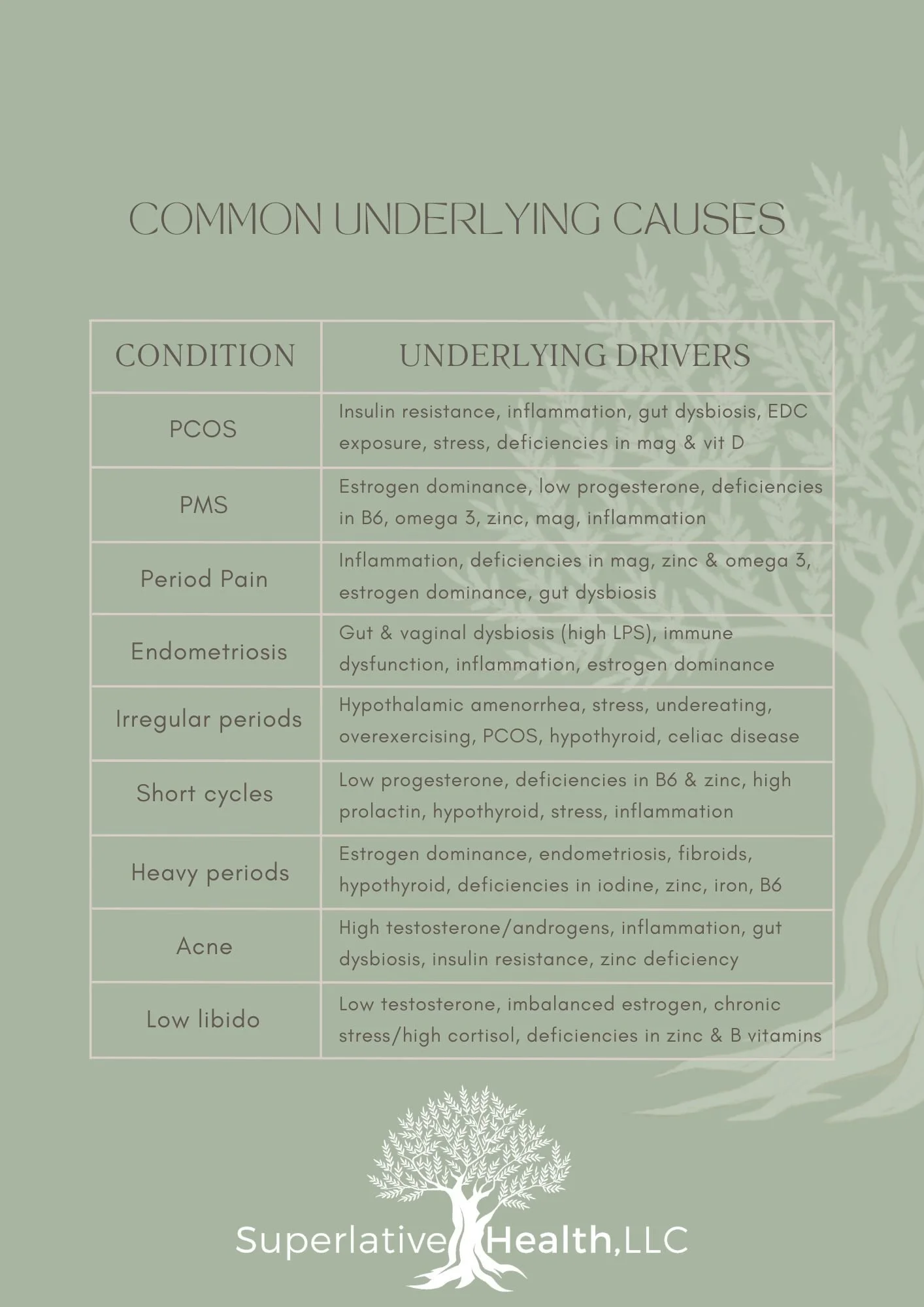
Come see me at Superlative Health, this is what I do best, help you walk through this and not guess at what you need, but test and actually see. Don’t throw money away by taking all kind of supplements, take what is actually best for you.
You are not alone.
If your cycle has been trying to tell you something and nobody has listened, email Melody at superlativehealthllc@gmail.com or book through the link below.
"Your period is not the problem. It is the monthly report. When we learn to read it — the colour, the timing, the pain, the mood shifts — everything about how to support your hormonal health becomes clearer."
Melody recommends
Your cycle has been trying to tell you something
Book a women's health consultation with Melody and find out what your body has been communicating all along.
TO BOOK NOWSources and Further Reading
Mahalingaiah S, et al. How menstrual cycles shed light on overall health. Harvard T.H. Chan School of Public Health. July 2025. hsph.harvard.edu/mahalingaiah-lab
American College of Obstetricians and Gynecologists. Menstruation in Girls and Adolescents: Using the Menstrual Cycle as a Vital Sign. Committee Opinion 651. 2015.
Office on Women's Health. Your menstrual cycle and your health. womenshealth.gov. Updated 2025.
Bruinvels G, et al. The Prevalence and Impact of Heavy Menstrual Bleeding Among Athletes. International Journal of Sports Physiology and Performance. 2021. — On cycle phase variation in nutrient needs, performance, and recovery.
Lara Briden, ND. Period Repair Manual. 2018. The most comprehensive plain-English guide to understanding and repairing menstrual health naturally.


Summer is one of the most abundant seasons for health — more sun, more movement, more fresh food. But it is also a season when sleep slips, hydration falls short, and immune foundations quietly erode. Melody Thomas shares her simple, natural approach to keeping the whole family well this summer, including an interactive guide to building your five-remedy homeopathic first aid kit.