
Flexibility and Functional Movement

Halfway through the summer and the baseball season, it seems like the perfect time to talk about functional movement, flexibility, and what we actually do here at Superlative Health. Medical massage may seem like it’s just a different way to say massage, but it’s not, there are many different elements that go into medical massage.
One of the major factors in a medical massage is increasing and improving a person’s functional movement, which is only possible when full range of motion is achieved by releasing contracted tissues. A key way for self care after receiving medical massage is increasing functionality and to focus on stretching and flexibility. Surprisingly, flexibility can be reduced by work or exercise that produces repeated overuse of the same muscles, succeeding in confining joints within a restricted range of motion. Flexibility is possibly the most important factor in the longevity of an athlete, so baseball players beware! The most flexible joint is the shoulder, which also means that the shoulder is very typically injured. Whether you’re throwing out a pitch, or simply repeatedly picking up and moving objects in your everyday life, the shoulder is an important part of the body to protect by practicing proper stretching techniques.
The primary obstacle to flexibility is the tightness of the surrounding muscles and fascia of the joint. Strong tensile forces of the muscle and fascia surrounding the specific joint determine flexibility. Trauma, overuse, and one's own bio-chemistry are the most common causes of muscle tightness, resulting in protective flexor postures, or over corrective postures that seem to help us feel better, but hurt us more in the long run. This is why stretching and relaxing the muscles is an important and necessary factor that must not be ignored.
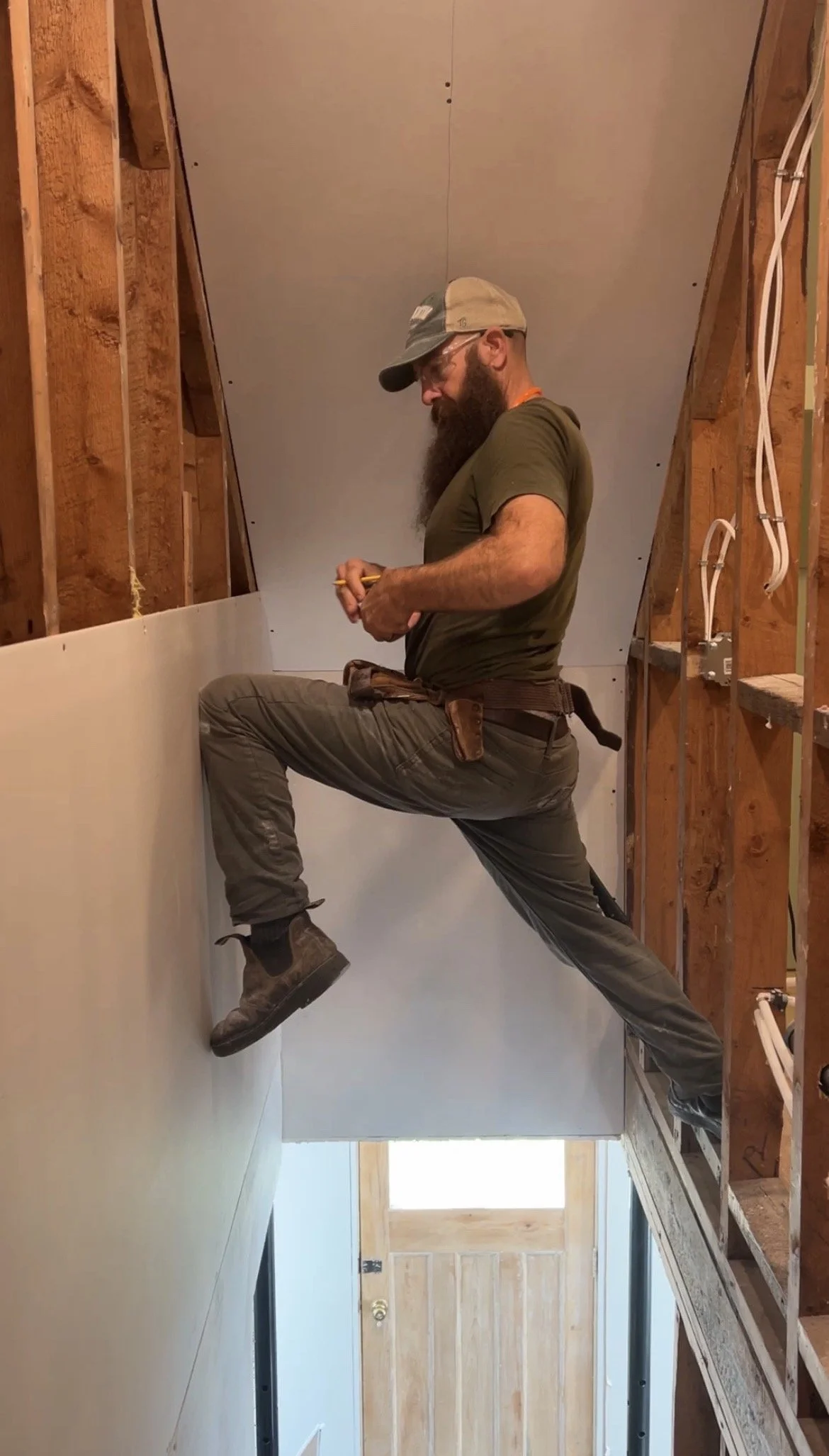
You never know when you need to move your body in interesting ways! My son-in-law John Mark installing drywall.
What Your Body Is Trying to Tell You — and Three Things You Can Do About It Today
I have been treating musculoskeletal dysfunction, pain patterns, and restricted movement for over two decades, and one of the most consistent observations I have made across thousands of patients is this: the body loses its functional range of motion quietly, gradually, and almost always without the person noticing until something hurts badly enough to demand attention.
By that point, the restriction has usually been building for months — sometimes years.
What Functional Movement Actually Means
Functional movement is the body's ability to move through the ranges of motion required for daily life — bending, reaching, rotating, lifting, walking, sitting, and standing — without compensation, pain, or restriction. When functional movement is intact, the body distributes load efficiently across multiple structures. When it is compromised, that load gets displaced onto structures that were never designed to carry it, and those structures eventually begin to break down.
The primary obstacle to functional movement is not weakness. It is tightness — specifically, the tightness of the muscles and surrounding fascia that constrain joint mobility. Strong tensile forces in the muscular and fascial matrix determine how freely a joint can move. Trauma, repetitive use patterns, postural habits, biochemical imbalances, and unresolved emotional holding patterns all contribute to that tightness over time.
The shoulder is the clearest example I see in clinical practice. It is the most mobile joint in the human body — and precisely because of that mobility, it is the most commonly injured. A pitcher throwing a baseball, a construction worker repeatedly lifting overhead, an office worker who has spent years with their shoulder elevated toward their ear while holding a phone — all of them are loading the same structures in the same restricted range, day after day, until something gives.
What I Do in a Medical Massage Session
When a patient comes to me with a movement restriction or pain pattern, I do not begin with deep pressure. I begin with assessment. I need to understand the full picture of what the tissue is doing — where the primary restriction is, where the secondary compensations have developed, and which structures are genuinely shortened versus which are in protective spasm because they are being asked to protect something else.
From that assessment, I select my approach. Typically I begin with myofascial release techniques to address the fascial restrictions that are limiting the deeper work, then progress to neuromuscular therapy and trigger point release to deactivate the hyperirritabile points that are both causing pain and perpetuating the restriction. This combination allows the tissue to soften and open in a way that deep pressure alone never achieves — because you cannot force a muscle out of a protective pattern. You have to create the neurological safety for it to release.
Once the tissue has responded, I may incorporate Active Release Technique, Positional Release, or Muscular Energy Technique depending on what the joint and surrounding structures need to recover their full range. The session ends with movement assessment to confirm that the changes made on the table are translating into actual functional improvement.
Three Things You Can Do Right Now to Improve Your Agility
Between sessions, the work of maintaining and improving functional movement belongs to the patient. Here are the three practices I recommend most consistently to my patients — not because they are the most advanced, but because they are the most consistently effective when done correctly and regularly.
1. The 90/90 Hip Mobility Drill
The hips are the foundation of almost every movement pattern in the body. When hip mobility is restricted — which it almost universally is in people who sit for significant portions of their day — the lumbar spine, knees, and shoulders all compensate, each taking on load they were not designed to carry.
Sit on the floor with both legs bent at 90 degrees — one knee in front of you and one to the side, both at right angles, feet relaxed. Sit as tall as possible with your spine long. Hold this position for two to three minutes, breathing slowly and deliberately. Then gently rotate to face the other direction, switching which knee is in front. Hold again.
What you are doing is applying a sustained, low-intensity load to the hip capsule and surrounding musculature — the external rotators, the hip flexors, the adductors — that allows those structures to lengthen through a neurological process called autogenic inhibition. Ballistic stretching cannot achieve this. Sustained positional loading over time is how the tissue actually changes.
Do this daily. Two minutes per side, every morning before you stand up from bed if possible.
2. Thoracic Extension Over a Foam Roller
The thoracic spine — the twelve vertebral segments between your neck and your lower back — is designed to extend, rotate, and flex. In most people I see in clinical practice, it is locked in flexion — collapsed forward from hours at a desk, a screen, a steering wheel. When the thoracic spine cannot extend, the cervical spine and lumbar spine both hypermobilize to compensate, producing the neck pain, headaches, and low back pain that bring most of my patients through the door.
Place a foam roller perpendicular to your spine, positioned at the mid-back — roughly at the level of your shoulder blades. Support your head with your hands interlaced behind your neck. Allow your upper back to gently drape over the roller, breathing out as you extend. Hold for thirty seconds, then shift the roller an inch or two up or down and repeat. Move through the entire thoracic region, spending thirty to sixty seconds at each level.
This is not aggressive. You should feel a gentle stretch and opening, not pain. If you feel sharp pain at any point, stop. Done consistently over several weeks, this practice restores thoracic extension, reduces compensatory strain on the neck and low back, and changes posture in ways that are visible and measurable.
3. Daily Passive Hamstring Loading — Legs Up the Wall
The hamstrings are the most consistently tight muscle group I address in clinical practice, and their tightness has consequences far beyond the back of the legs. Chronically shortened hamstrings tilt the pelvis posteriorly, flatten the lumbar curve, and increase compressive load on the lumbar discs — contributing significantly to the low back pain patterns that are among the most common musculoskeletal complaints in adults.
Lie on your back with your hips close to a wall and extend your legs up the wall as straight as they comfortably allow. Your legs do not need to be perfectly vertical — wherever they rest without forcing is correct. Stay here for five to ten minutes, breathing slowly. The sustained gravitational load creates a passive stretch through the entire posterior chain — hamstrings, calves, and fascia of the lower limb — without any active muscular contraction that would trigger the stretch reflex and limit the tissue's ability to lengthen.
This is also one of the most effective practices I know for nervous system downregulation — the elevation of the legs activates the parasympathetic response, reduces cortisol, and begins to quiet the sympathetic overdrive that keeps so many of my patients in chronic tension.
Five minutes before sleep, legs up the wall, every night. The cumulative effect on hamstring length, pelvic alignment, and sleep quality is significant.
The Role of Regular Medical Massage
These three practices are powerful tools for maintaining the gains made in the clinical setting — but they are not a substitute for assessment and hands-on treatment when genuine restriction exists. The body develops patterns of compensation that self-care alone cannot fully unwind, because the nervous system has learned to protect those patterns as normal. Skilled clinical manual therapy interrupts those patterns at a neurological level that stretching and mobility work simply cannot access.
Regular maintenance appointments allow me to identify and address restrictions before they become pain. They allow the tissue to be assessed by trained hands that can distinguish between a muscle that is tight because it is overworked and a muscle that is tight because it is compensating for something else entirely. And they give the body consistent permission — through skilled, informed touch — to release the holding patterns it no longer needs.
A person may come in for a medical massage and expect to be worked and massaged on a table the entire time, but this is not often the case. A person must first be evaluated for their injury or problem area, and then after, myofascial release techniques, the muscles are ready for deeper findings and use of trigger point therapy to release the contracted soft tissue so they can recover range of motion, allowing them to stretch.
Making regular maintenance appointments for Medical Massage and learning how to stretch properly will help ease the strain on a muscle, and taking the time for self care means a lot to your body, and it will thank you for it!
→ Book your Medical Massage session with me at Superlative Health in Burke, Virginia →