Is your Desk the issue?
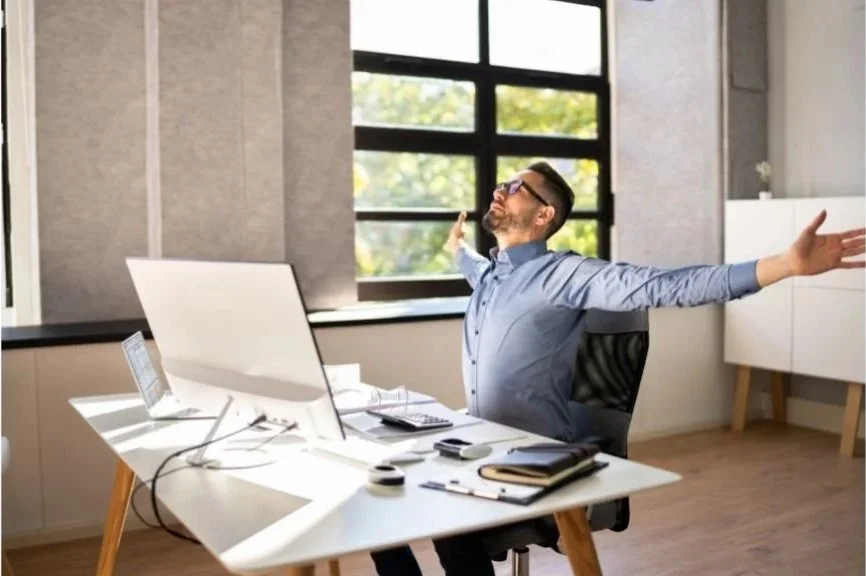
YOUR DESK IS UNDOING YOUR WORKOUT The biomechanics of desk setup, the structural compensations it produces, and what Marcus at 28 needed to understand before the pattern became permanent
Marcus's Story
Marcus came to see me at 28 with hips that felt like concrete and an upper back that rounded forward even when he was consciously standing tall. He was not the patient I typically associate with postural breakdown, he was young, strong, training three times a week, eating well, and doing everything the fitness world told him to do. He could deadlift twice his bodyweight. He could not fully extend his hips.
The first thing I assessed was not his training program. It was his workday.
Ten hours at a desk. A monitor set too low. A chair that was too high for his leg length, producing a hip flexion angle beyond ninety degrees for most of his working day. A keyboard positioned so far forward that his shoulders were in sustained protraction whenever his hands were on it. A phone he looked down at for an additional two to three hours daily on top of the screen time.
His training was excellent. His environment was producing structural compensations faster than his training could address them. And until the environment changed, the compensations would continue to rebuild themselves between every session he did to address them.
This is the post for Marcus, and for every young, fit person who cannot understand why their body is not reflecting the work they are putting into it.
The Head — How Much It Actually Weighs When You Move It Forward
The average adult human head weighs between ten and twelve pounds in neutral alignment, balanced directly over the cervical spine with the ears over the shoulders. In this position the deep cervical flexors and the posterior cervical muscles share the load efficiently and the intervertebral discs of the cervical spine are subjected to their designed compressive forces.
For every inch the head moves forward of this neutral position, which happens every time you lean toward a screen that is too low or too far away, the effective compressive load on the cervical spine increases dramatically. At one inch forward, the effective load is approximately twenty-seven pounds. At two inches, forty pounds. At three inches, forty-two pounds. At the four to five inch forward head position that is typical of sustained screen use, the cervical spine is managing an effective load of fifty to sixty pounds on a structure designed for ten to twelve.
This sustained overload produces several predictable clinical consequences. The posterior cervical muscles, the suboccipitals, the semispinalis, the upper trapezius — become chronically overloaded and develop the trigger points that generate the headaches, the neck aching, and the referred pain into the shoulders and upper back that Marcus was experiencing. The anterior cervical structures become chronically shortened. The cervical intervertebral discs are subjected to abnormal anterior compression. The thoracic outlet — the space through which the brachial plexus and subclavian vessels pass from the neck into the arm, becomes progressively compressed by the hypertrophied scalene and pectoralis minor muscles that develop in response to the forward head posture.
The fix for Marcus was not more stretching. It was raising his monitor so that the top third of the screen was at eye level, which positioned his gaze at the natural downward angle of comfortable vision without requiring his head to drop forward to achieve it. This single change reduced the effective load on his cervical spine by approximately thirty pounds for every hour he spent at his desk.
The Chair — Why Height Matters More Than Cushioning
Most people choose a desk chair based on comfort. Comfort, in most chair designs, means a seat that is soft, a back that supports the lumbar curve, and a height that allows the feet to rest flat on the floor. The last of these is correct. The others are more nuanced than most people realize.
Chair height determines hip flexion angle, the angle between the torso and the thigh when seated. At ninety degrees of hip flexion, which is the position most chairs produce, the hip flexors are at a shortened length and the posterior hip capsule is under sustained tension. The gluteal muscles, which are the primary hip extensors and the most important muscles for lumbar stability and hip function, are in a sustained stretched and inhibited position.
At hip flexion angles greater than ninety degrees, which occur when the chair is too high for the person's leg length, causing the thighs to slope downward from hip to knee — the hip flexor shortening is amplified, the posterior hip tension increases, and the lumbar spine is pulled into a progressively flattened or flexed position that increases disc compression in the posterior lumbar space.
Marcus's chair was too high. His thighs were sloping downward. His hip flexion angle was closer to one hundred and ten degrees than ninety. His psoas was spending ten hours a day in a shortened position that no amount of hip flexor stretching in the gym could adequately counteract.
The adjustment was simple, lower the chair until the thighs were approximately parallel to the floor or very slightly downward sloping from hip to knee, with the feet flat. This immediately reduced his hip flexion angle, reduced the psoas shortening, and allowed his gluteal muscles to begin contributing to his postural support rather than being switched off by the chair position.
The Keyboard and Mouse — The Shoulder Story Nobody Tells
The position of the keyboard and mouse relative to the body determines the sustained resting position of the shoulder girdle for every minute of computer use. Most desk workers have their keyboard too far from their body — requiring a sustained forward reach that holds the shoulder in protraction, the elbow in extension, and the wrist in extension or radial deviation for hours at a time.
Sustained scapular protraction — the forward rounding of the shoulders produced by a keyboard that is too far away — has several significant clinical consequences. The pectoralis minor, which runs from the coracoid process of the scapula to the third, fourth, and fifth ribs, becomes chronically shortened in the protracted position. A tight pectoralis minor depresses and anteriorly tilts the scapula, impairs the shoulder's ability to elevate freely, and compresses the structures of the thoracic outlet — the brachial plexus, the subclavian artery and vein — producing the numbness, tingling, and weakness in the arm and hand that characterizes thoracic outlet syndrome.
The rotator cuff muscles — subscapularis, supraspinatus, infraspinatus, teres minor — are designed to function with the scapula in a retracted, posteriorly tilted position that maintains the sub-acromial space and allows the humeral head to glide freely in the glenoid during arm movement. In sustained protraction, this space is reduced, the rotator cuff tendons are subjected to increased impingement loads during any overhead movement, and the pattern that produces rotator cuff tendinopathy and eventual tearing in middle-aged desk workers begins its progression.
Marcus was not going to develop thoracic outlet syndrome or rotator cuff pathology at twenty-eight. But the pattern producing those outcomes in his patients twenty years his senior was already fully established in his tissue — and addressing it at twenty-eight rather than forty-eight is incomparably easier.
The keyboard should be positioned so that the elbows are at approximately ninety degrees of flexion with the upper arms hanging relaxed at the sides, the forearms parallel to the floor, and the wrists in neutral. This position requires the keyboard to be significantly closer to the body than most desk setups produce — and it immediately eliminates the sustained protraction load on the shoulder girdle.
The Phone — The Hidden Structural Load
If there is one ergonomic factor that I have watched produce the most dramatic structural change in patients under forty in the last decade, it is the posture of phone use. Specifically, the hours of daily forward head flexion produced by looking down at a handheld screen held at chest or waist height.
The cervical spine loads described earlier apply fully here — but the angle is typically worse than screen use, and the duration has increased dramatically as screen time has migrated from the desktop to the pocket. A patient who spends two hours daily looking down at their phone is adding the equivalent of eighty to one hundred pounds of cumulative cervical compressive load to their day on top of whatever their desk is already contributing.
The solution is simple in principle and difficult in practice — raise the phone to eye level rather than dropping the head to phone level. For most people this requires a conscious override of a deeply habitual pattern that has been established over years of smartphone use. The postural retraining required to establish the new habit is real work — and it is work that I address through the postural realignment component of my clinical sessions.
The Standing Desk — What Nobody Tells You About It
Standing desks have been widely adopted as the solution to the sitting problem, and I want to address this directly because the enthusiasm for them often exceeds the nuance required to use them effectively.
Standing is better than sitting for many of the physiological reasons I have described. It reduces hip flexion angle, reduces lumbar compression in the posterior disc space, allows greater diaphragmatic excursion, and produces more lymphatic flow in the lower extremities. These are genuine benefits.
Standing for eight hours, however, is not better than sitting for eight hours. It is differently problematic. Sustained standing produces its own pattern of postural fatigue — the lumbar spine moves into hyperextension as the hip extensors fatigue, the knees move into hyperextension as the quadriceps fatigue, the feet pronate and the arches collapse as the foot intrinsic muscles fatigue. The varicose veins that affect many people who spend significant time standing are a direct consequence of the sustained hydrostatic pressure on the lower extremity venous system without the muscle pump action that intermittent movement provides.
The answer is alternation — not standing instead of sitting, but moving between sitting, standing, and brief movement throughout the day. The research suggests that alternating between sitting and standing every thirty to sixty minutes, combined with the movement snack practices described in my previous post, produces significantly better outcomes than either sustained sitting or sustained standing alone.
For Marcus, a sit-stand desk with a thirty minute alternation timer was the environmental change that, combined with the clinical work I did on his tissue, allowed his training gains to finally hold between sessions rather than being progressively unwound by his working day.
What the Clinical Work Addresses That Ergonomics Cannot
Ergonomic improvements prevent the pattern from worsening. They do not release the structural compensations that have already been built. The forward head posture that has been developing for three years has produced fascial densification, trigger points, joint restriction, and neuromuscular inhibition patterns that the correct monitor height cannot undo. The hip flexor shortening that has been developing since Marcus started his first desk job at twenty-two will not release because his chair is now at the right height.
For the structural work that has already accumulated, I use Active Release Technique and Myofascial Release for the fascial restrictions and soft tissue adhesions, Neuromuscular Therapy for the trigger points generating referred pain through the neck, shoulder, hip, and lower extremity, and Myoskeletal Alignment for the combined skeletal and soft tissue compensations across the full kinetic chain.
For patients who cannot come in for hands-on work, telehealth consultations allow me to assess the full picture of what is happening in the body based on a detailed description of the pain pattern, the movement limitations, and the postural picture — and build a personalized daily movement and rehabilitation plan that addresses the specific compensations present. For the pain and inflammation already established, homeopathic medicine chosen for the specific character of the presentation, peptide therapy for tissue repair and joint health, and personalized frequency patches imprinted from the Qest4 scan provide continuous therapeutic support between sessions.
Marcus's hips are no longer concrete. His upper back no longer rounds forward when he stands. His training gains hold between sessions now because the environment producing the compensations has been addressed and the tissue that had already adapted to the old environment has been clinically reset.
He sent his younger brother to see me last month. His brother is twenty-four and works at the same tech company. Same desk setup. Same emerging pattern. Twenty years earlier in the arc than Marcus was when he came in.
That is the ideal time to start.
→ Book your ergonomic assessment and clinical session at Superlative Health in Burke, Virginia, or start with a telehealth consultation. Tell me your setup, your pain picture, and your goals — and I will build your plan.