Movement SNACKS
MOVEMENT SNACKS — WHY THIRTY SECONDS EVERY THIRTY MINUTES CHANGES EVERYTHING The neuroscience of movement breaks, the five desk practices that interrupt fascial stiffening before it compounds, and why Sarah's neck pain was not a bedtime problem
Sarah's Story
Sarah came to see me at 34 with a neck that hurt every single evening without fail. She was not someone who neglected her health. She ate well. She took her supplements. She tried to get to a yoga class when her three-year-old's schedule allowed it, which was not often. She had tried three different pillows. She had tried stretching before bed. She had tried the ergonomic advice she had found online, which amounted to sit up straight and take breaks, without any specificity about what breaks meant or what to do during them.
What Sarah had not yet understood — and what I told her in our first session — was that the problem was not happening at night. It was not her pillow. It was not her mattress. It was not even primarily her posture, though her posture was certainly part of the picture. The problem was happening between 9am and 6pm, at her kitchen table, in a position her cervical spine was never designed to sustain for nine consecutive hours. By the time she got to her pillow, the damage was already done.
The solution was not going to be found at bedtime. It was going to be found at 9:30am.
The Thirty Minute Rule — Why Frequency Matters More Than Duration
Most people think about movement in terms of exercise — a block of activity lasting thirty minutes or more, scheduled once or twice a day, designed to compensate for the hours of inactivity surrounding it. The research on fascial biology and tissue mechanics tells a more nuanced and more actionable story.
Fascia — the connective tissue matrix that envelops and connects every structure in your body — begins to stiffen and lose its hydration within approximately twenty to thirty minutes of sustained static posture. This is not a gradual linear process. It has a threshold. Below the threshold, the tissue remains adequately hydrated and pliable. Above it, the ground substance of the fascia begins to gel — thickening, stiffening, and beginning the densification process that, over months and years, produces the structural restrictions that bring patients to my table.
What interrupts this process is not a thirty minute workout. It is movement — any meaningful movement — introduced before the threshold is reached. Thirty seconds of thoracic rotation. A ninety second hip flexor release. Standing and taking three full diaphragmatic breaths. Any input that changes the mechanical load on the fascia, stimulates the interstitial fluid movement, and resets the hydration clock.
This is the movement snack: a brief, targeted, frequent movement practice introduced throughout the day rather than consolidated into a single session at its beginning or end. And the research is consistent: movement frequency produces greater fascial hydration, greater reduction in inflammatory cytokine accumulation, greater improvement in pain scores, and greater improvement in tissue quality than equivalent total movement time consolidated into longer, less frequent sessions.
For Sarah, this was the reframe that changed everything. She did not need more time. She needed more “snacks” through her day. Body movement snacks that is. And the five practices I am about to describe take a combined total of under two minutes, making them genuinely executable regardless of how demanding her day is.

Five Movement Practices for Desk Workers — What They Are and Why They Work
Practice One — Thoracic Rotation
The thoracic spine — the twelve vertebral segments between your neck and lower back — is designed to rotate, extend, and flex. In most desk workers I assess, it has lost the majority of its rotation range and virtually all of its extension capacity, locked in a posture of forward flexion that it has been maintaining for years.
The consequence of thoracic immobility is significant and far-reaching. When the thoracic spine cannot rotate, the cervical spine and lumbar spine both hypermobilize to compensate — producing the neck pain and lower back pain that are the most common complaints I treat. When the thoracic spine cannot extend, the shoulder blades lose their ability to move correctly on the thoracic wall — producing the shoulder impingement, rotator cuff dysfunction, and upper back pain that desk workers accept as normal.
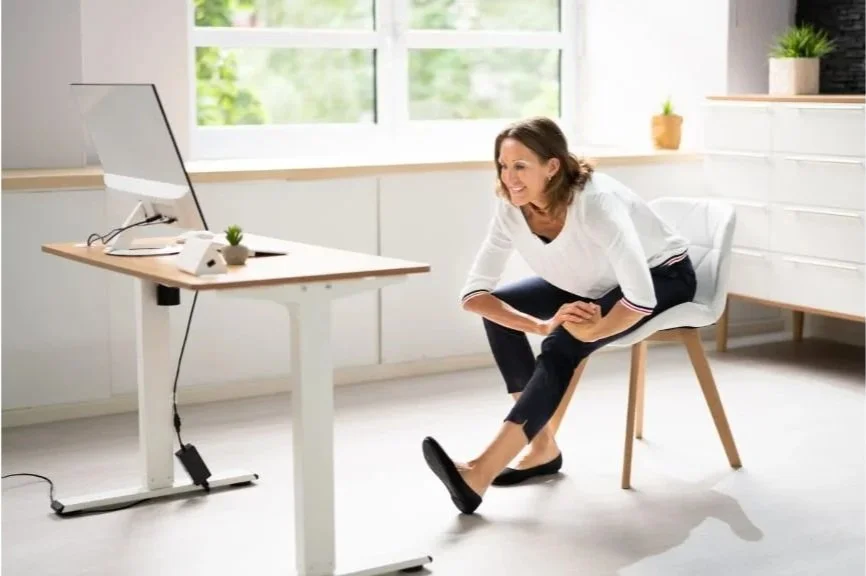
Sit at the edge of your chair with your feet flat on the floor and your spine as tall as you can make it. Cross your arms over your chest. Rotate your upper body slowly to the right as far as you comfortably can. Hold for two full breaths. Return to center. Rotate left. Hold for two breaths. Three repetitions each side. The rotation should come from the thoracic spine — your hips and lower body stay facing forward throughout. This practice takes ninety seconds and begins restoring the thoracic rotation that your cervical and lumbar spines desperately need your thoracic spine to reclaim.
Practice Two — Standing Hip Flexor Release
The psoas and iliacus — your primary hip flexors — are held in a shortened, contracted state for every minute you spend sitting. Over time this produces the adaptive shortening that pulls the lumbar spine into compression, tilts the pelvis anteriorly, and creates the lower back pain and hip tightness that most desk workers carry as a constant background feature of their physical experience.
Stand up from your chair. Take a long step forward with your right foot, lowering your left knee toward the floor in a lunge position. Keep your trunk upright — do not lean forward. Tuck your tailbone very slightly under to flatten the lumbar curve and feel the stretch deepen in the front of the left hip. Hold for sixty seconds, breathing slowly and allowing the hip flexor to release into the position rather than forcing it. Switch sides. This practice takes approximately two minutes and directly counteracts the sustained shortening your hip flexors have been accumulating all morning.
Practice Three — Cervical Retraction
For every inch the head moves forward of its neutral position over the cervical spine, the effective compressive load on the cervical spine increases by approximately ten pounds. In the average desk worker, the head is carried four to five inches anterior to neutral during screen use — producing an effective load of fifty to sixty pounds on a cervical spine designed to carry ten to twelve. This is the mechanism generating Sarah's evening neck pain. Not her pillow.
Cervical retraction — commonly called a chin tuck — directly addresses forward head posture by activating the deep cervical flexors, the small muscles that stabilize the cervical spine in neutral alignment, and gently decompressing the posterior cervical joints that are being compressed by the forward head position.
Sit tall. Without moving your chin up or down, draw your head directly backward — as if making a double chin. You should feel a gentle stretch at the base of the skull and a mild muscular effort in the deep front of the neck. Hold for five seconds. Release. Repeat ten times. This practice takes sixty seconds. Done every thirty minutes throughout the day it begins retraining the cervical spine toward neutral alignment and reducing the sustained compression that was generating the pain Sarah was attributing to her pillow.
Practice Four — Shoulder Blade Setting
The shoulder blades — scapulae — are designed to move freely across the posterior thoracic wall in response to arm and shoulder movement. In desk workers, the combination of forward head posture, thoracic kyphosis, and sustained forward arm position produces a pattern of scapular protraction — the shoulder blades are drawn forward and around the thoracic wall, the muscles that retract and stabilize them become chronically lengthened and inhibited, and the anterior shoulder structures become chronically shortened and overloaded.
This pattern is the proximate cause of the majority of shoulder, rotator cuff, and upper back pain I assess in desk workers — and it is the easiest to interrupt with a brief, targeted practice.
Sit tall. Draw your shoulder blades gently back and down — as if you were trying to tuck them into your back pockets. Do not shrug them upward. Hold the retraction for five seconds, breathing normally. Release completely. Repeat ten times. This practice takes sixty seconds, directly activates the lower and middle trapezius and rhomboids that have been inhibited by the protraction pattern, and reduces the anterior shoulder loading that produces the deep aching in the front of the shoulder that many desk workers describe at the end of a long day.
Practice Five — Diaphragmatic Reset
This is the practice most people skip because it does not feel like movement — and it is arguably the most important of the five.
The diaphragm is the primary breathing muscle and one of the most important postural stabilizers in the body. In a sustained seated position, with the psoas tight, the thoracic spine flexed, and the abdominal cavity compressed, the diaphragm's excursion is progressively restricted — producing the shallow, chest-dominant breathing pattern that activates the sympathetic nervous system, chronically loads the accessory breathing muscles of the neck and upper back, and reduces lymphatic flow through the thoracic duct.
Stand up. Place one hand on your chest and one on your abdomen. Inhale slowly through the nose for a count of four — the hand on your abdomen should rise while the hand on your chest remains relatively still. Hold for two counts. Exhale slowly through the mouth for a count of six. Three to five repetitions. This practice takes sixty seconds and directly resets the diaphragmatic breathing pattern that sustained sitting progressively suppresses. It also activates the vagus nerve through the extended exhale — shifting the autonomic nervous system toward parasympathetic dominance and reducing the cortisol load that accumulates across a sustained day of desk work.
Setting Your Movement Snack Timer
The single most impactful implementation decision you can make after reading this post is not which of these five practices to start with. It is to set a repeating timer on your phone or computer for every thirty minutes during your working day.
When the timer goes off, stand up. Do one practice. Sit back down. That is it. The entire intervention takes under two minutes and resets the fascial stiffening clock before the threshold is reached. Done consistently across an eight hour working day, you are interrupting the pattern sixteen times rather than allowing it to compound uninterrupted for eight consecutive hours.
The cumulative effect of that frequency — over weeks, over months — is measurably different tissue. More hydrated fascia. Less trigger point formation. Less chronic muscular tension in the cervical and thoracic spine. Less psoas shortening. Less scapular protraction. A body that arrives at bedtime in a fundamentally different physiological state than one that has sat through eight hours without interruption.
Sarah's neck stopped hurting every evening within three weeks of consistent practice. Not because anything dramatic had changed. Because the pattern that had been building all day, every day, was now being interrupted before it could reach the threshold that produced the pain.

When Movement Snacks Are Not Enough — And What Comes Next
I want to be honest about the limits of this intervention, because I believe patients deserve accuracy not just encouragement.
Movement snacks interrupt the accumulation of new fascial stiffening and prevent the pattern from worsening. What they cannot do — on their own — is release the fascial densification, trigger points, and structural compensations that have already been built up over months or years of uninterrupted sitting. For that work, hands-on clinical intervention is needed.
If you are already in pain — if the neck ache is not just at the end of the day but with you consistently, if the lower back ache does not respond to movement, if the shoulder restriction is limiting your range — the movement snack practice is a valuable daily maintenance tool, but it is not the primary treatment. The primary treatment is a skilled clinical assessment of what your tissue has built and a targeted manual therapy approach to systematically address it.
If you cannot come in person I offer telehealth consultations where you describe your pain picture in full and I build a personalized daily movement and rehabilitation plan specific to your body and your presentation. This is not a generic protocol. It is a plan built around what your specific tissue needs based on everything you tell me about where, when, how, and under what circumstances the pain occurs.
And for the pain that is already present — the sciatic involvement, the nerve pain down the arm or leg, the lower back inflammation that movement snacks alone cannot resolve — I use homeopathic medicine chosen for the specific character of your pain, peptide therapy for tissue repair and anti-inflammatory support, and personalized frequency patches imprinted from your Qest4 scan to deliver continuous corrective support between sessions.
The movement snack is where you start. The clinical work is where the pattern actually changes.
→ Book your session at Superlative Health in Burke, Virginia, or start with a telehealth consultation. Describe your pain picture and I will build your personalized plan.